
The MEA said the two sides shared their perspectives on the matter in the talks held in a friendly and cordial atmosphere.
Her comments come a day after External Affairs Minister S Jaishankar said in Geneva that roughly 75 percent of the "disengagement problems" with China are sorted out but the bigger issue has been the increasing militarisation of the frontier.
India on Thursday blamed China's actions of amassing a large number of troops close to the border and attempts to unilaterally alter the status quo along the Line of Actual Control (LAC) last year for the continuing military standoff in eastern Ladakh, and asserted that these acts were in violation of Sino-India bilateral agreements.
'The Galwan Valley clashes helped us prioritise our national security approach towards the northern border'

It is learnt that the face-off took place after a Chinese patrol tried to enter Indian territory and the troops of China's People's Liberation Army were forced back.
The comments by External Affairs Ministry Spokesperson Anurag Srivastava came at a media briefing when asked about the fresh comments by the Chinese foreign ministry blaming India again for the border situation in eastern Ladakh.
Asked about the continued tensions along the border and whether the PLA troops action was anyway related to the disagreements with the Indian government's plan to lure business out of China, Chinese Foreign Ministry spokesman Zhao Lijian said both the countries were in diplomatic contact over the face-off between their troops.

The Chinese military on Friday confirmed that the troops of China and India have begun the process of disengagement from the Patrolling Point 15 in the Gogra-Hotsprings area of eastern Ladakh in a 'coordinated and planned way'.
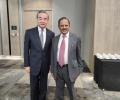
National Security Advisor Ajit Doval held a meeting with top Chinese diplomat Wang Yi during which he emphasised the need for continuing efforts to restore peace and tranquillity in the border areas to remove the 'impediments' to normalcy in bilateral relations.
The actions on the ground would be confirmed and are expected to be followed up soon.

External Affairs Minister S Jaishankar on Thursday asserted that India's relationship with China cannot be normal unless there is peace in the border areas and there is no ambiguity in New Delhi's signalling to that country.

The move comes amid hectic diplomatic manoeuvring between the two countries over a host of issues like Nuclear Suppliers Group and designation of Masood Azhar as a terrorist by the United Nations.

Describing the situation along the Line of Actual Control in Ladakh as "well under control", a top army commander on Friday said the force is committed to launch "intelligence specific and people friendly" operations to counter the ongoing proxy war in Jammu and Kashmir.

Asked about the reports of the troops on both sides disengaging and moving back to their previous positions, Chinese foreign ministry spokesperson Hua Chunying told a media briefing in Beijing that both sides are taking steps to ease the situation along the borders.
Singh also said that India will give a befitting reply to anyone threatening its unity, sovereignty and territorial integrity as it no longer remained a "weak" country.
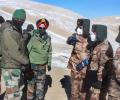
Indian Army Chief General M M Naravane had said on Wednesday that India was hopeful of resolving issues related to disengagement at Patrolling Point 15 (Hot Springs) in eastern Ladakh in the 14th round of talks.

It was the second time in the last three days that India asserted that the relationship with China depends on the resolution of the pending issues in eastern Ladakh.

Jaishankar said that both sides also exchanged views on the next steps in the India-China bilateral ties.

He said that the government of India has never accepted this illegal occupation.
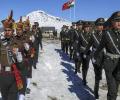
The hotline is between the Indian Army in Kongra La, North Sikkim and China's People's Liberation Army (PLA) at Khamba Dzong in Tibetan Autonomous Region, they said.
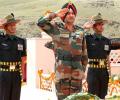
Lt General Ranbir Singh described the situation in Kashmir as stable but fragile.
Chinese military has also deployed a sizeable number of its troops in Galwan Valley, the site of the violent clashes on June 15 that left 20 Indian soldiers dead.
China's state-run media said that the leadership of the two countries successfully solved the Doklam standoff in 2017 with 'concerted efforts and wisdom'.

The sources said Singh will carry out a comprehensive review of the security situation in the region with Gen Naravane, Northern Army Commander Lt Gen Yogesh Kumar Joshi, Commander of the 14 Corps Lt Gen Harinder Singh and other senior army officials.

As the military standoff between India and China drags on along the Line of Actual Control (LAC) in eastern Ladakh, Defence Minister Rajnath Singh said the talks between the two sides are going on well and indicated hope for a resolution of the lingering row.

The deliberations focused on bringing down tension along the disputed borders and ways to bridge the trust deficit.
Chinese Foreign Ministry spokesman Wang Wenbin said this at his media briefing as he parried questions on India's assertion that consensus reached by the leaders on maintaining peace along the border cannot be swept under the carpet.
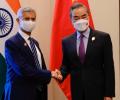
India and China are likely to hold the 16th round of high-level military talks on July 17 to resolve the issues in remaining friction points along the Line of Actual Control (LAC) in eastern Ladakh, people familiar with the development said on Wednesday.

China's military on Thursday asked the Indian Army not to take any "unilateral actions" affecting the stability of the border areas, days after the Indian side removed a Chinese-built hut in the Ladakh sector.

India said it is strongly committed to ensuring its sovereignty and territorial integrity.
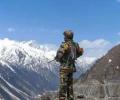
Asserting that sovereignty and territorial integrity of China are "sacred and inviolable", the country's national legislature has adopted a new law on the protection and exploitation of the land border areas, which could have bearing on Beijing's border dispute with India.

"Don't expect miracles in resolving the issue. What we are trying is that till a satisfactory solution on boundary issue is found, whenever incidents take place on border, through discussions and official mechanism, resolve those issues. Of late, we have been able to resolve the issues without much delay. That is an improvement," Defence Minister AK Antony said.
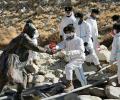
India and Chinese troops on Saturday exchanged sweets and greetings at 10 border posts along the Line of Actual Control (LAC) including in eastern Ladakh to mark the New Year, officials said.

People familiar with the development said on Friday that the Chinese envoy held wide-ranging talks with the external affairs ministry's point person for Afghanistan J P Singh.
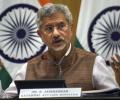
Jaishankar, speaking at a virtual event hosted by the Asia Society, said that India has built the relationship with China over the course of last 30 years "and a basis for building that relationship has been peace and tranquillity along the Line of Actual Control".
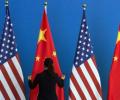
Throughout its standoff with India along the Line of Actual Control (LAC), Chinese officials sought to downplay the severity of the crisis, emphasising Beijing's intent to preserve border stability and prevent the standoff from harming other areas of its bilateral relationship with India, the Pentagon said in a report on Tuesday.
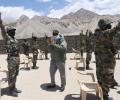
Only he, with his tremendous political capital and personal stature, can pull it off, observes B S Raghavan, the veteran civil servant.
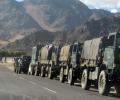
India on Friday said the onus is on China to address the remaining unresolved issues relating to the eastern Ladakh row and that peace and tranquillity along the frontier were key for the restoration of normal relations between the two sides.

India and China on Tuesday discussed the recent spate of incursions and ways to maintain peace and tranquility along the Line of Actual Control in the border areas.
Jaishankar said India had agreements with China not to mass force in the border areas.
